College of Environmental Studies
Ikebukuro Campus
OBJECTIVE.
Developing environmental leaders needed for a new era
About
College of Environmental Studies
Building on Rikkyo University's extensive expertise, the college offers an innovative program centered on liberal arts education delivered by faculty from both the social sciences,humanities and natural sciences. It also features environmental leadership education in which every student is encouraged to exercise leadership, as well as field studies that connect students with the front lines of environmental action both in Japan and abroad.
The program is designed to cultivate multifaceted perspectives for understanding the environment, leadership that sparks dialogue and collaboration, and the practical ability to connect specialized knowledge with real-world situations. In addition, it seeks to foster a shared commitment to transforming society based on environmental justice—a movement that confronts inequities embedded in environmental issues and strives to build an equitable society.
Students in the College of Environmental Studies engage in field studies from their first year, learning about complex real-world environmental issues while acquiring foundational, cross-disciplinary knowledge in environmental studies, including the natural and social sciences and the humanities. This approach allows them ample time to choose the specialized field they wish to pursue.
In their third and fourth years, students conduct research in their chosen fields and participate in more practical projects. Through interaction with peers who have diverse interests and specialties, as well as with professionals and citizens across society, they develop a holistic view of environmental studies and define their own role within this field.
Department
-
Department of Environmental Studies
For a new era:
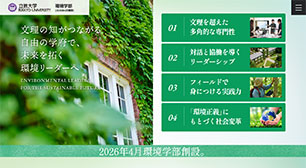
Creating an inclusive society and a thriving natural environmentThree Features of of the Department of Environmental Studies—What does studying at this department mean?
1. Integration of social sciences/humanities, natural sciences and fieldwork to nurture environmental leaders
We welcome applicants from all academic backgrounds, whether their interests lie in the natural sciences, social sciences, or humanities. We offer novel educational programs that emphasize fieldwork and are grounded in Rikkyo’s strengths in liberal arts, leadership, and global education.
2. Practical learning to confront global environmental issues
We provide opportunities for hands-on learning about global environmental challenges, including climate change, biodiversity loss, and marine pollution. Students examine real-world environmental challenges in Japan and abroad while engaging with those on the front lines of a wide range of these issues.
3. The power of dialogue and collaboration in team problem-solving
From their first year, students engage in project-based learning in partnership with corporations and local communities. By interacting with individuals from diverse backgrounds and specialties, they develop the skills in dialogue and collaboration essential to on-site action.Abilities and knowledge acquired at the Department of Environmental StudiesーWhat abilities does this department cultivate?
Multifaceted expertise spanning the social sciences, humanities, and natural sciences
Our interdisciplinary faculty provides a liberal arts education that integrates the social sciences, humanities, and natural sciences. While deepening their specialized knowledge, students develop an attitude of not being bound to a single perspective or way of thinking.
Leadership that drives dialogue and collaboration
Through Rikkyo’s distinctive leadership education, we cultivate next-generation environmental leaders who can facilitate dialogue and collaboration toward Green Transformation (GX), carbon neutrality, and sustainable communities. This program is designed to harness each student's unique strengths and strengths, while also drawing out the strengths of others.
Practical skills forged through fieldwork
In addition to mandatory domestic field studies, students develop advanced practical skills through real-world experiences in Japan and abroad. In collaboration with local communities, corporations, and government agencies, these experiences enable them to take action toward realizing a sustainable society.
Cultivating Rikkyo-style leaders through liberal arts and sciences
Students gain a robust foundation in the natural sciences while simultaneously adopting the analytical perspectives of the humanities and social sciences. This balanced approach allows them ample time to define their own area of specialization. Through Rikkyo’s signature leadership education and extensive field studies, the department cultivates next-generation environmental leaders equipped to drive dialogue and collaboration.
Intended learning outcomes
-

Gain broad foundational knowledge of the environment from the perspectives of the natural and social sciences and the humanities and deepen understanding by connecting this knowledge to real-world challenges.
-

Develop a scientific understanding of the natural environment and learn to apply technologies and academic knowledge of socio-economic systems appropriately in each context.
-

Contribute to local and global communities through dialogue that connects diverse stakeholders and experts across fields, while exploring collaborative relationships.
-

Understand the concept of environmental justice and take action to address environmental issues and drive change toward a sustainable society.
Learn more
For more information, please visit the links below.